 RIFT
RIFTArticle · 21 August 2026
The assault goes on its own
It's the most radical difference between RIFT and the card games it descends from, and the one people hold against us most often, before playing.
What the others do
In a classic card game, combat is a negotiation in three beats: I declare my attackers, you declare your blockers, we do the maths. That's where most of the game is played, and it's magnificent, for anyone with the time, the table, and an opponent across from them.
It's also what makes a game long to play, hard to follow from a distance, and next to impossible to hold in one hand on the train.
What RIFT does
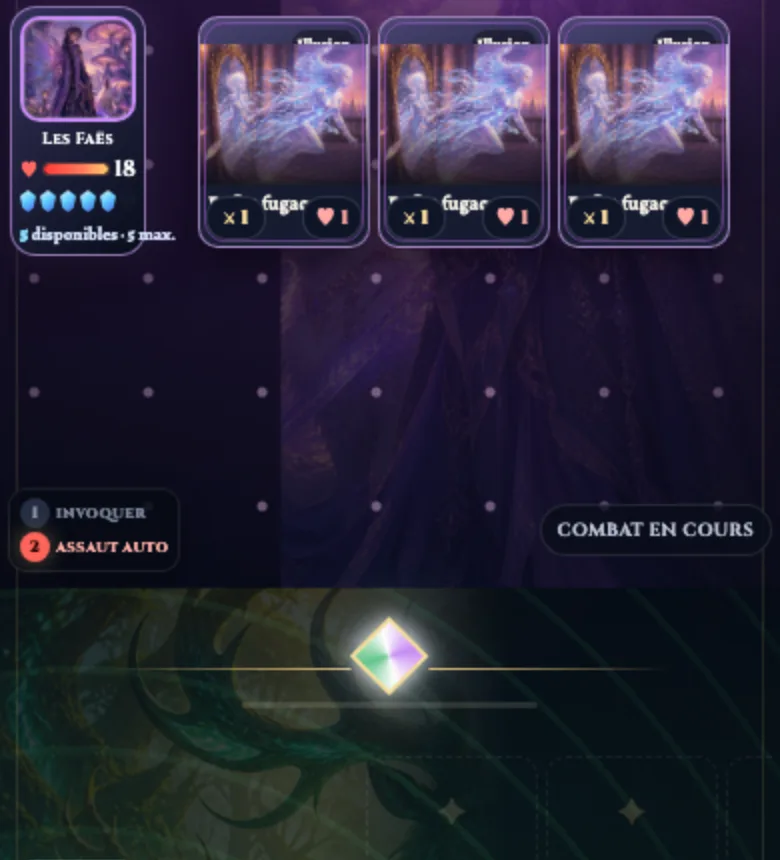
The two strongest allies cross the Rift on their own. The player chooses when, never who.
There is nothing to point at, nothing to tick, nothing to drag. When you judge your board ready, you launch the assault, and it goes. The maths is done by the game; the decision stays whole.
Because the real decision isn't "who attacks". It's earlier: which creatures I laid down, in what order, across three slots only, knowing that the two strongest will leave. An ally you summon is an ally you send.
Three consequences we hadn't foreseen
The game becomes readable from a distance
Someone watching over your shoulder understands the game in ten seconds. There is no invisible phase, no priority passing, no in-between state.
Guards get their full weight back
Since you don't choose your target, a creature with Guard across the table really does change your plan: it absorbs, and you have to build differently. The keyword stops being a tax and becomes an obstacle.
Preparation becomes the heart of the game
And that is exactly where combos come in: they land on their own when the right ingredients meet inside your turn. All the tension shifts towards building the turn, not towards the arithmetic of combat.
What it costs, honestly
We lose a tactical layer, and it's a beautiful one. Bluffing over blocks, working out the favourable trade, the last-second surprise: none of that exists in RIFT, and nothing will replace it.
It's a trade we own. We give up one kind of depth to gain another, and above all so that a game fits under one thumb, on a commute, without ever having to put the phone down to count.
Jean-Christophe Martinez · author of RIFT
The waiting list
Try it once, and judge afterwards
One address, and you're told at launch, early January 2027.