Longer pieces on the design decisions: what was chosen, what it costs, and what was turned
down.
More will come: the combos, the Rift as a third
player, and what it is like to make a card game on your own.
The game's symbols become heraldry
The soul, the attack, the life and the guard are no longer characters borrowed from your phone's font. They are now four pieces of heraldry, drawn by the game itself: the lozenge, the arrowhead, the drop and the shield.
They were chosen for a simple reason: these shapes were invented to be recognised from a distance, on a battlefield. They stay sharp at every size, and take on the colour of your kingdom.
The world's language opens up
All the peoples speak the same language, and none of them knows why. It is called Khron. The world page now shows its writing, sixteen signs, a few everyday words, and two rules of grammar.
What each sign says has never been published. The steles of the necropolises are covered in them, and they are still waiting to be read.
One card, explained piece by piece
The "how to play" page now shows a real card from the game, at its exact size, with the name of each of its parts around it. Behind it, the book of rules, open.
The rules are written in an italic engraved on copper in 1680, chosen because it was drawn to be read small. They arrive in Khron, and let themselves be translated with a gesture.
Those who defy the kings
The site showed the sovereigns. It now also shows those who stand against them: one hero per kingdom, with a face and what set them on the road.
None of them has a name, and that is deliberate. The one you play is you.
The quest no longer ends at the last victory
Beating the three kingdoms no longer closes the game. The campaign opens again, and what you thought you had finished was only the first third. Three acts, each one higher than the last.
What the final one unlocks will not be said here. Let us say that after it, the rules will never be quite the same.
Sound comes back on iPhone
On iPhone, the little side switch muted the entire game, without a word. Safari took its music for a ringtone. The game now declares itself as a music player, and the switch no longer applies to it.
Nobody reported this fault: people simply concluded the game had no sound.
An update no longer interrupts your game
The banner announcing a new version could appear over a duel in progress, and the "reload" button destroyed the game.
It now waits for the duel to end. The version is never forgotten, only deferred until the moment when saying yes costs nothing.
The rules now appear at your first duel
They only appeared in the campaign. Anyone starting a skirmish, the shortest path from the home screen, landed on a board without a line of explanation.
They now appear at the first duel, whatever the mode, once only.
The phone gets its space back
The top bar folds into a single button, giving the board back the pixels it took for four controls you touch once a game. Your hand tightens instead of running off the screen.
And in landscape, the game finally tells you to turn the phone, instead of serving a cramped screen without a word. RIFT is played in portrait, and that is a choice.
The graveyard and the deck finally show
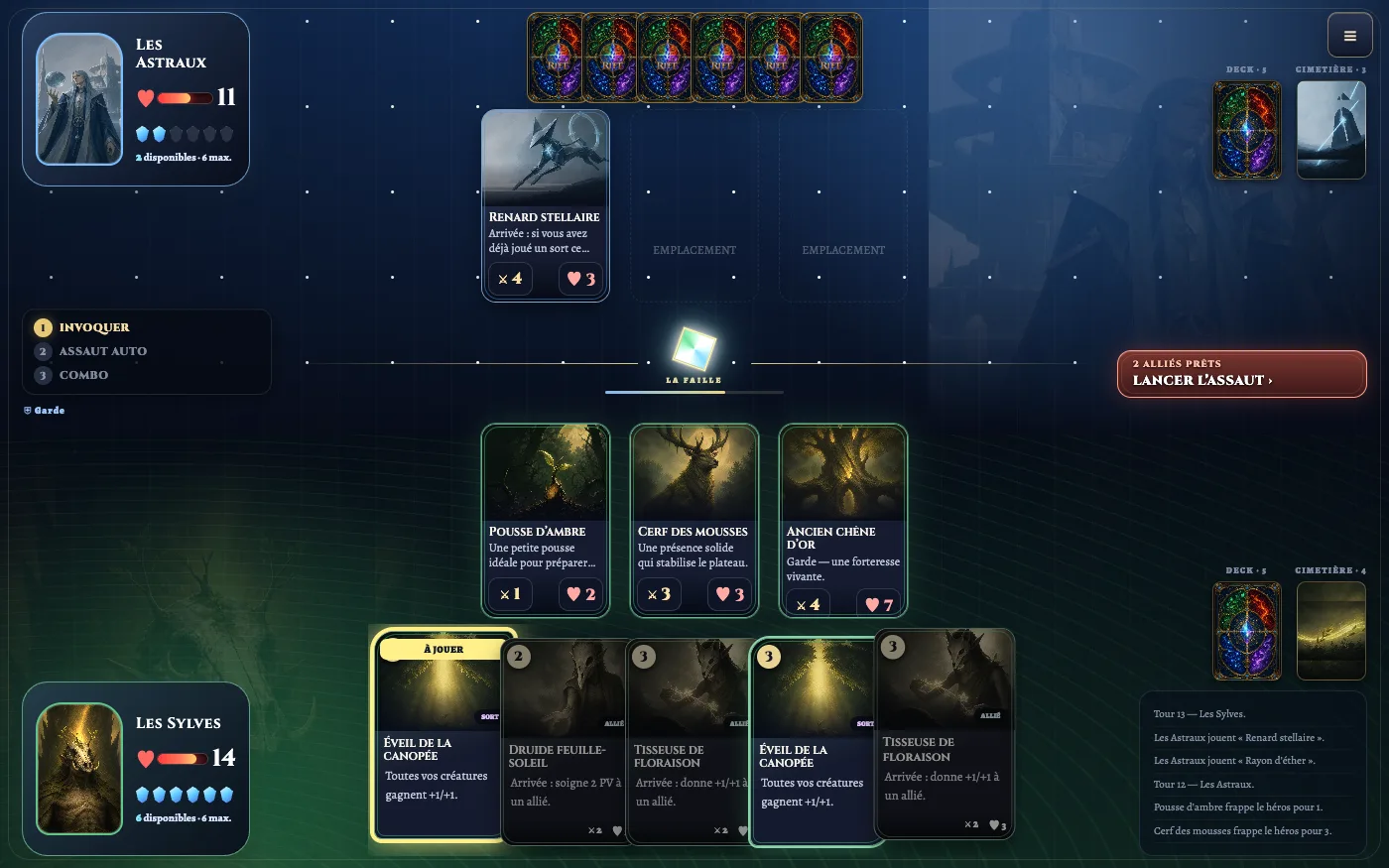
The game had always counted your remaining cards and your dead, and showed them nowhere on phone. Both piles are there now, with their exact count.
The graveyard matters: more than one combo is played by knowing what has already fallen.
The golden card rises when you win it
It comes up from the depths, face down and flat, straightens as it turns, and the gold takes it at the moment it faces you.
A face-down card already gleaming would give the surprise away.
The ending screen finally shows the whole scene
On phone, the victory and defeat illustrations were cut in half. They now show in full, and the pre-duel encounter has been redone for portrait: each side has its own band.
Pass the phone
The two local duel screens, the one between kingdom choices and the one between turns, now take the stone and obsidian of the rest of the game.
No kingdom colour appears on them: between the two choices, your opponent must not know what you picked.
Eighty illustrations redrawn by hand
The sixty cards, the fifteen generals, the sovereigns, the ending screens and the kingdoms: everything has been redrawn, in a single style, from the author's pencil sketches.
Dark painting, reduced palette, no drawn outline, a single light source. And the game weighs less than before: 16.3 MB down to 10.9 on this batch.
Golden cards enter play
They stayed in your collection without ever reaching your hand. Now each golden card replaces its own original in your deck, never another card.
Measured over twelve hundred games: they win you eight and a half points more. Real help, not a steamroller.
The Rift widens as the quest goes on
It opens as the kingdoms fall. Three stages, on the flat board and on the table in volume alike: the tear widens, the light rises, and the dust slowly turns towards it.
Outside the campaign it stays shut: a skirmish has no story behind it. And it grows without ever coming closer, so it hides nothing of the table.
The grimoire carries real cards
The cards of your collection sit on the two pages of a book you turn, two per page, and the page pivots on its spine like a real leaf.
The number was not chosen but measured: a page is 534 by 701, and two cards at the game's format fit exactly.
Your settings stay put
Difficulty and sound survive a reload, and follow across your tabs. This was not comfort: you literally could not change level, the setting fell back to Adventurer on its own.
Your opponent stops repeating itself
Each general had one line per situation. It now has three, that is one hundred and eighty instead of sixty.
The choice follows the turn, not chance: two identical games tell the same story.
Faces are no longer squashed
Card thumbnails filled their frame, and so squashed the artwork by 23 %. On every face, every screen, since forever.
They are now cropped, never stretched. A stretched face does not look broken, it looks slightly different, and that is why it lasted so long.
The game loads twice as fast
Thirteen and a half megabytes given back on first load, without touching a single illustration. That was what left you with a black portrait while it arrived.
The site speaks English
Every page has its English twin, and a selector links them. The journal itself comes from a single source in both languages.
The site finally shows the game as it is
All eighty illustrations in the game were redrawn in a single day. The site already carried them for the kingdoms and the cards, but not its screenshots, which dated from 21 August and therefore showed a game that no longer exists.
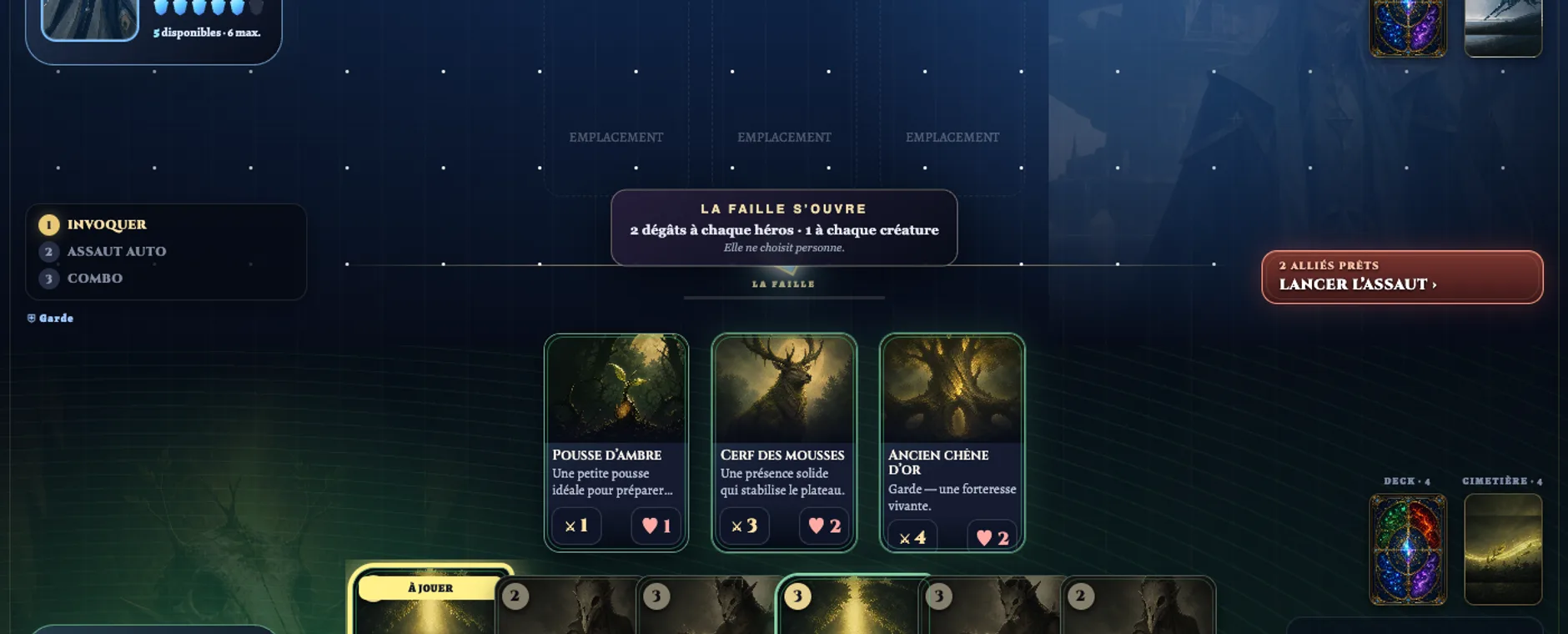
They have been retaken on a game played for real: the board mid-match, the Rift opening and announcing its damage, and the table in 3D. Along the way, the card thumbnails are no longer squashed by 23 % in height, a flaw that had been there from the start and that nobody had measured.
One kingdom is drawn and stays off the site until it is ready to be shown.
The four sovereigns sat down at the table
Each one facing you, each with their own way of holding their cards: the Sylves lay theirs down and wait for them to grow, the Astraux have already seen how it ends, the Cendrés don't know how to lose, and the Faës cheat without really hiding it. That may be all you need to know about the kingdoms before choosing one.
The Faës got their new face right after: all four kingdoms are now drawn by the same hand. And every banner now carries its kingdom's setting behind it, the stump, the forge, the frost stairway, the gate-tree.
One kingdom is still being drawn. It isn't on the site, and that is deliberate.
The kingdoms finally have a face, and a map
Jean-Christophe is redrawing the hundred illustrations of the game. The first ones have arrived, and the site already carries them: the Sylves, a gaunt people, an animal skull over the face, and the Cendrés, whose sovereign is a queen of fire with a hammer. The home banner has been redone too: until now it was only a game interface background cropped into a banner.
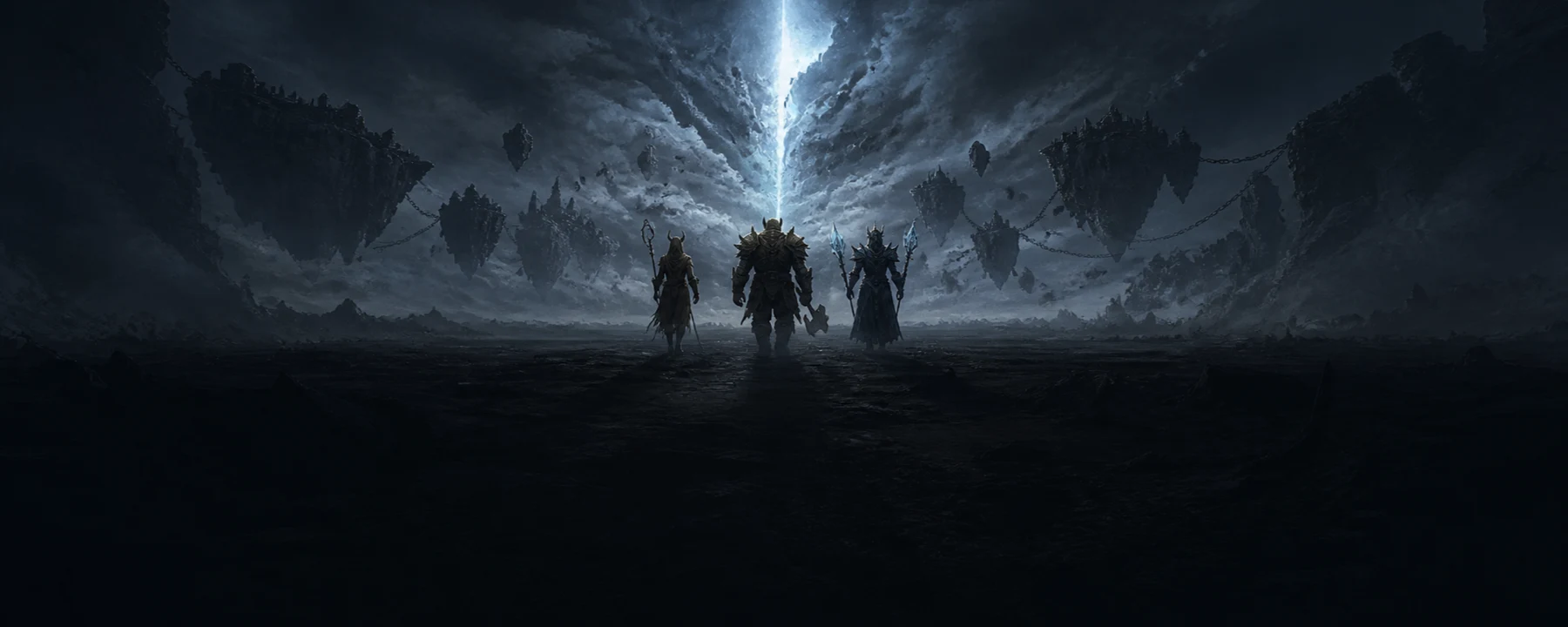
And the site finally shows where it all happens. Four islands hanging around the tear, held by chains: the map had been missing from the start, and the kingdoms were being told about without ever being placed. It comes in two crops, because the wide version becomes unreadable on a phone.
The Astraux and the Faës are still waiting their turn: their portraits are the old ones. The difference shows, and that's normal, the work is under way.
You get to watch the game before playing it
The "See the game" button on the home page led nowhere: it pointed at an anchor that didn't exist. It was drawn, it could be clicked, and it did nothing. A dead anchor raises no error and writes nothing to the console, the browser ignores a missing one in silence. It is fixed, and a test now compares the two lists on every page of the site.
It leads to a second film, cut today: five sequences filmed on the running game, choosing your clan and its kingdom, the sixty cards of the grimoire, a turn played out, a combo firing on its own, and the game won. Thirty-eight seconds, no mock-ups. The trailer itself hasn't changed: it tells the kingdoms, this one shows the match.
Neither player still downloads a single byte of video before you have clicked.
The site takes on the ornaments of RIFT
Section headings have become runic cartouches, engraved in gold, with their ornaments on either side. The callout boxes have the same golden line and the same sunken edge.
This isn't decoration laid on top: it's the kit drawn for RIFT, used as it is. Thirty-nine labels and six boxes, across the eight pages of the site.
Along the way, the screenshot of the game in 3D still carried the app's own header, you could read "3D duel against the opponent" in the corner. It's gone, without any cropping: the turn indicator and the Rift gauge deserved to stay.
RIFT has its trailer, and its music
One minute sixteen at the top of the home page: the four kingdoms, a real game on the flat board, the table rising into 3D, and a two-player duel on the same phone.
None of it is a mock-up. The gameplay shots are filmed on the running game, combos firing on their own, the Rift striking both sides, the damage climbing. What you see is what you'll play.
The music is original, composed by Jean-Christophe Martinez for this film. It never starts on its own: sound arrives when you press play, never before.
On a computer it plays in wide format, on a phone in vertical, you have nothing to choose, the page serves the right version. And until you click, no video is downloaded at all.
The full trailer, with the voices of the kingdoms, is one click away.
Boosters fall silent, the golden card takes their place
Opening random packs said nothing about what you had achieved. The reward that counts is now one golden card per sovereign defeated.
Nothing is deleted: the boosters are sleeping, and can come back.
The release is announced: early January 2027
A date we can bring forward, never push back. That is why it is taken generously.
The site and the game each have their own address
The site is open to everyone. The game stays behind a password until it is ready, and has an address of its own.
Every kingdom has its own music
Until now you crossed the kingdoms to the theme of your own clan. Twelve duels in a row, the same colour throughout. From now on it's the music of the one you're facing that plays, you're entering someone's home, and you hear it.
The general appears on his own theme: image and sound arrive together.
Your opponent answers back
The portrait of the general you're facing is now on his card, on the table in 3D, instead of his clan's emblem. You can see who you're fighting.
And he speaks. When he lands a hit, a line drops beside him, signed with his name. It changes with how much life he has left: above two thirds he ignores you, in between he takes the blow without saying so, below a third he has nothing left to spare. You read his state in his voice before you look at his gem.
Golden cards have to be earned
A Gold card used to drop after every duel won. You had them all very quickly, and they were worth nothing. It now takes one kingdom defeated per card, and each one has to be won.
Booster packs, meanwhile, are resting. They'll come back to enrich the game, for now we're building the part that has to stand on its own.
The game tells you when it has changed
RIFT installs on your home screen and works offline. The side effect is that a new version could take a visit to appear, without anything saying so.
A discreet banner now announces it, with a button to reload. "Later" closes it, and that version won't come back to bother you.
The illustrations arrive twice as fast
Some screens appeared before their illustration, a portrait stayed black until it turned up. On a phone over 4G, that wasn't an instant.
The images now weigh half as much, without a single one being changed: 97 megabytes brought down to 52. It isn't drawing, it's plumbing, but it's what makes a screen open instead of load.
The Rift finally acts
The game is called RIFT and the Rift was nothing but a dividing line between two sides. It now has a state that rises with what happens on the table, and at its threshold, it strikes both sides. Nobody owns it.
Its settings don't come from taste. Three versions were tried and measured over two thousand games played by the machine against itself; we kept the one that opened the smallest gap between kingdoms.
Energy becomes souls, and the Ecliste appears
The resource you spend to summon is no longer called "energy" but souls, the ones the Rift grants after the first exchange. What you play with now comes, explicitly, from what threatens you.
And a creature converts them: the Ecliste, a shard of the Rift set at the edge of the table. It's the one you call on to end your turn. Where there was a button, there is someone.
The table in 3D moves to the rules of RIFT
The 3D board made you click each creature, then its target, one by one. It had become another game: in RIFT, the assault goes on its own. That's fixed, the two strongest allies cross the Rift together, and the player only chooses when.
The Rift is now a beam rising from the ground to the sky, with its gauge. You can also read a card there before playing it: it comes and lies flat, at its true size. You never read in perspective.
The campaign gets a face
Four trials per kingdom, an illustrated general at every gate, and a Guardian who grows as the throne comes closer. Twenty general's lines have been written and put in.
The difficulty was measured, then corrected. It runs through the opponent's level, never through gifted health: a boss doesn't cheat.
Balance, measured rather than guessed
Two campaigns won "fairly easily": rather than touch up cards on instinct, the engine played against itself, every kingdom against every other, and produced win rates.
Verdict: the kingdoms were balanced, it was the difficulty that wasn't. We corrected numbers, not impressions.
19 and 20 August 2026
InterfaceThe board, redone properly
Bands on a computer, the graveyard and the deck visible and illustrated, a discreet menu in place of the banner, card text in full lines and at the right size. The opponent's cards can finally be read.
The two-player duel on a single device is played in two steps: each of you picks a kingdom out of the other's sight, then you hand over the phone.
The voices and the cutscenes
Twenty-eight lines of narration recorded for the kingdoms. The scenery keeps its proportions whatever the window size, and a scene you've already watched can be watched again.
Subtitles stay on screen at all times: you can play without a single sound and lose nothing of the story.
Two days lost to black cards
In the deck builder, some cards were showing up entirely black on iPhone. Two causes were stacked on top of each other, and both opening theories were wrong: only measuring the pixels actually painted settled it.
The lesson stuck: measuring tells you how much, looking tells you whether it's good, and you need both, every time.
This journal is kept by Savera.
 RIFT
RIFT