 RIFT
RIFTOne game
One turn, three phases, always in the same order
You cannot change that order, and that is exactly what makes the combos possible. Everything below is captured on the running game, none of it is a mock-up.
In motion
The game, filmed as it runs
A minute and a quarter. The cards, a full turn, the Rift striking both sides, the table flat and in volume. Nothing is a mock-up. Sound only starts when you press play.
The board
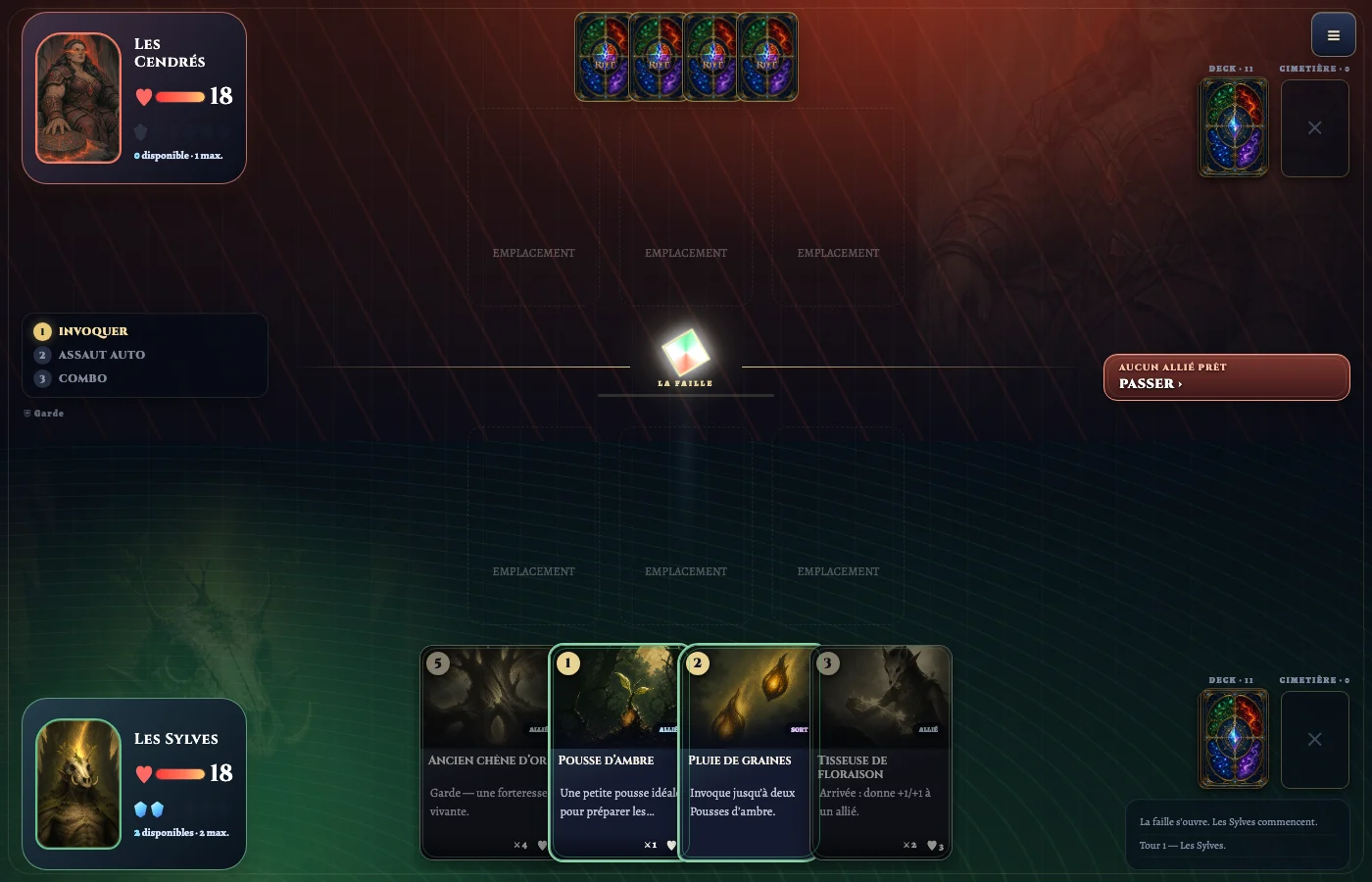
Everything is on one screen
One card
Everything on it, and nothing more
Six pieces of information, always in the same places. No sixth line to learn, no reminder text, no cross-reference to a manual.
 5
The Sylves
5
The Sylves
 Ancien chêne d’or
Garde, une forteresse vivante.
 4
JOUER
7
4
JOUER
7
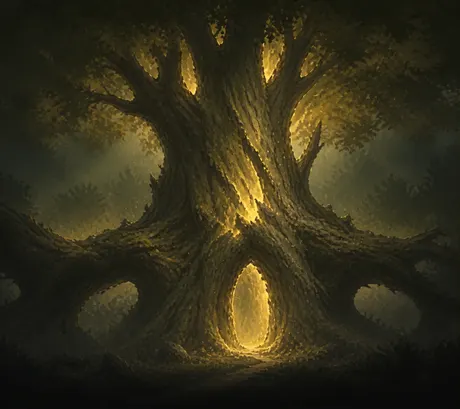
The cost5 souls. They come back in full every turn, and you gain one more, up to six.The typeThe emblem says creature or spell. A creature stays on the table ; a spell acts and is gone. The effectOne line, never two. Guard is the only keyword in the game : it intercepts the assault aimed at your hero.The attack4, what it takes away when it strikes.The life7, what it absorbs before it falls.
Ancien chêne d’or. Rare, The Sylves. It is rendered here to the game's own standard : 272 × 408, a two-line border, and the same emblems as on screen.
The turn
What happens, in order
-
You summon
Laying a creature or casting a spell costs souls. You have one on the first turn, one more each turn, six at most, and they refill completely at the start of your turn. Nothing to draw, nothing to manage: both players have exactly the same means at the same moment.
-
The assault goes on its own
Your two strongest allies cross the Rift together. You choose when, never who: there is nothing to point at, nothing to drag, and no blockers declared across the table. The real decision came earlier, which creatures you laid down, in what order, across three slots only.
-
Combos land
If the right ingredients met during your turn, the combo fires by itself. There is no button to find and no combination to memorise: fifteen exist, three per kingdom, and they arrive because you played well.
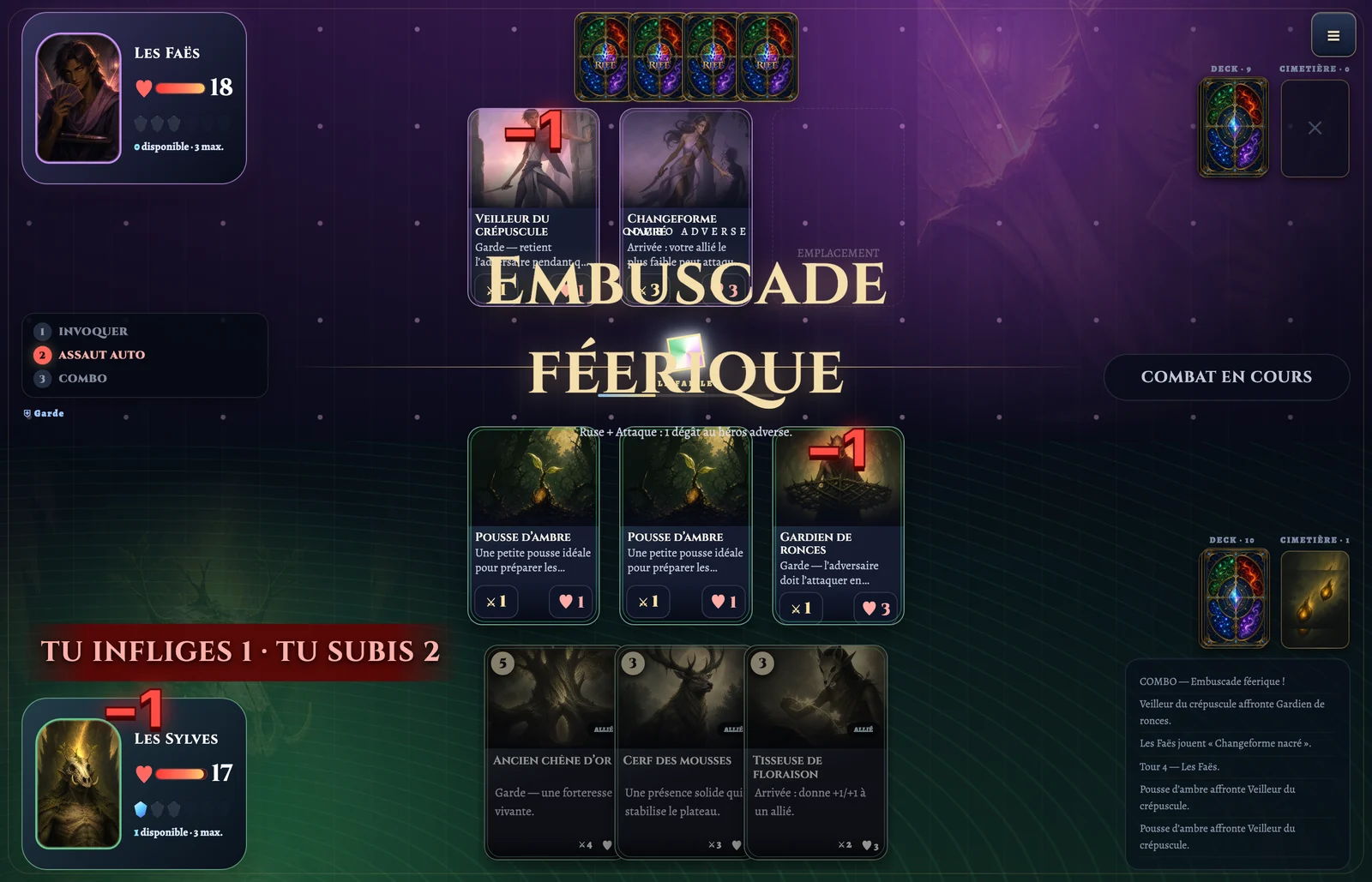
A combo, for real
The game names it, and tells you why
The third player
The Rift strikes both sides
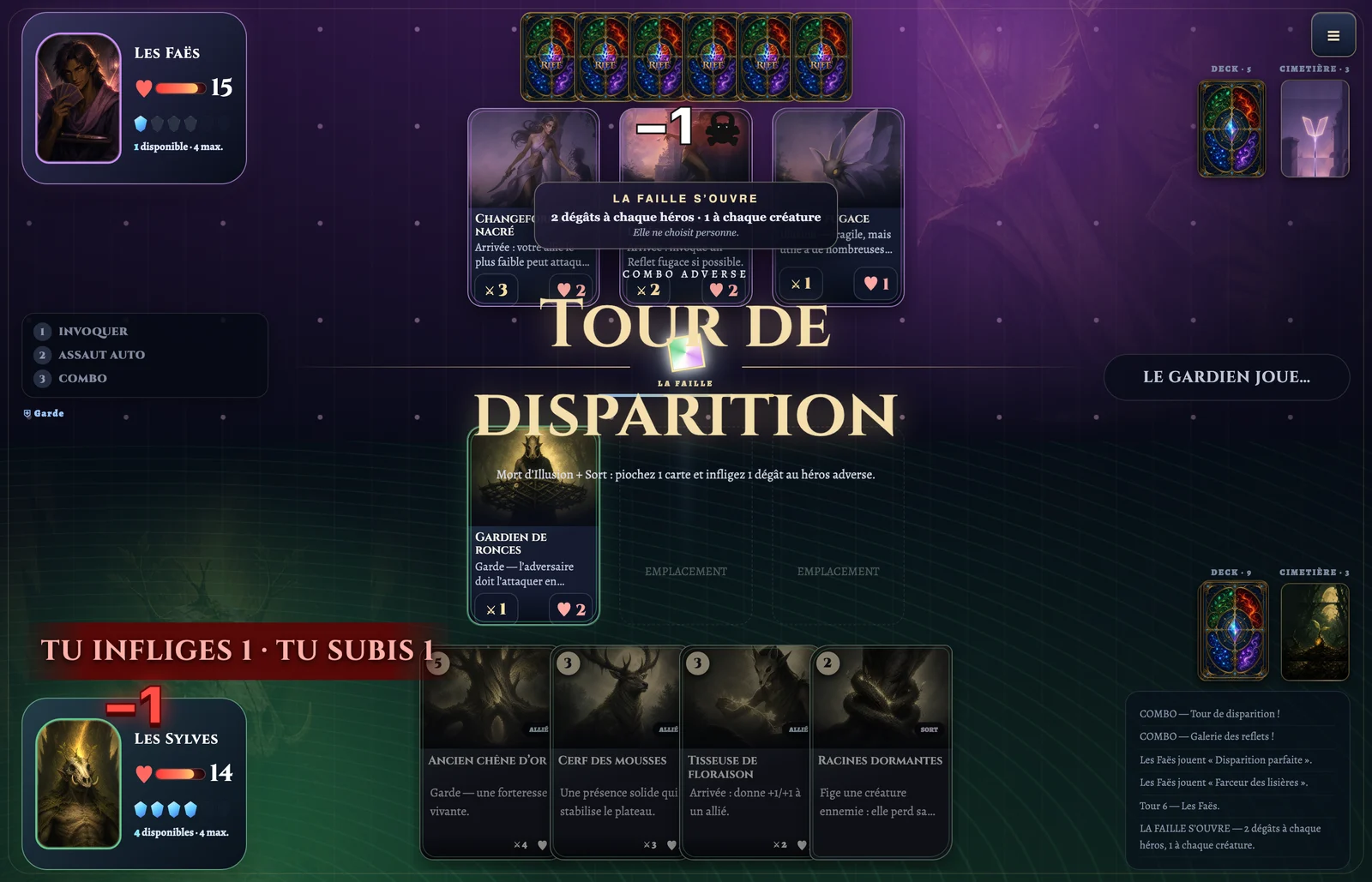
It is the one thing at the table that belongs to nobody. Where it comes from.
What RIFT doesn't have
Four things left out, on purpose
- No lands. Nobody loses to an unplayable hand: souls rise on their own. Why, and what it costs.
- No attack declaration, no blocking. You choose the moment, the game does the maths. What that changes.
- No interrupts. Nobody plays during your turn, so nothing is decided in an in-between state you can't see.
- No endless game. The deck is fifteen cards and fatigue arrives when it runs out: a game always ends.
On a phone
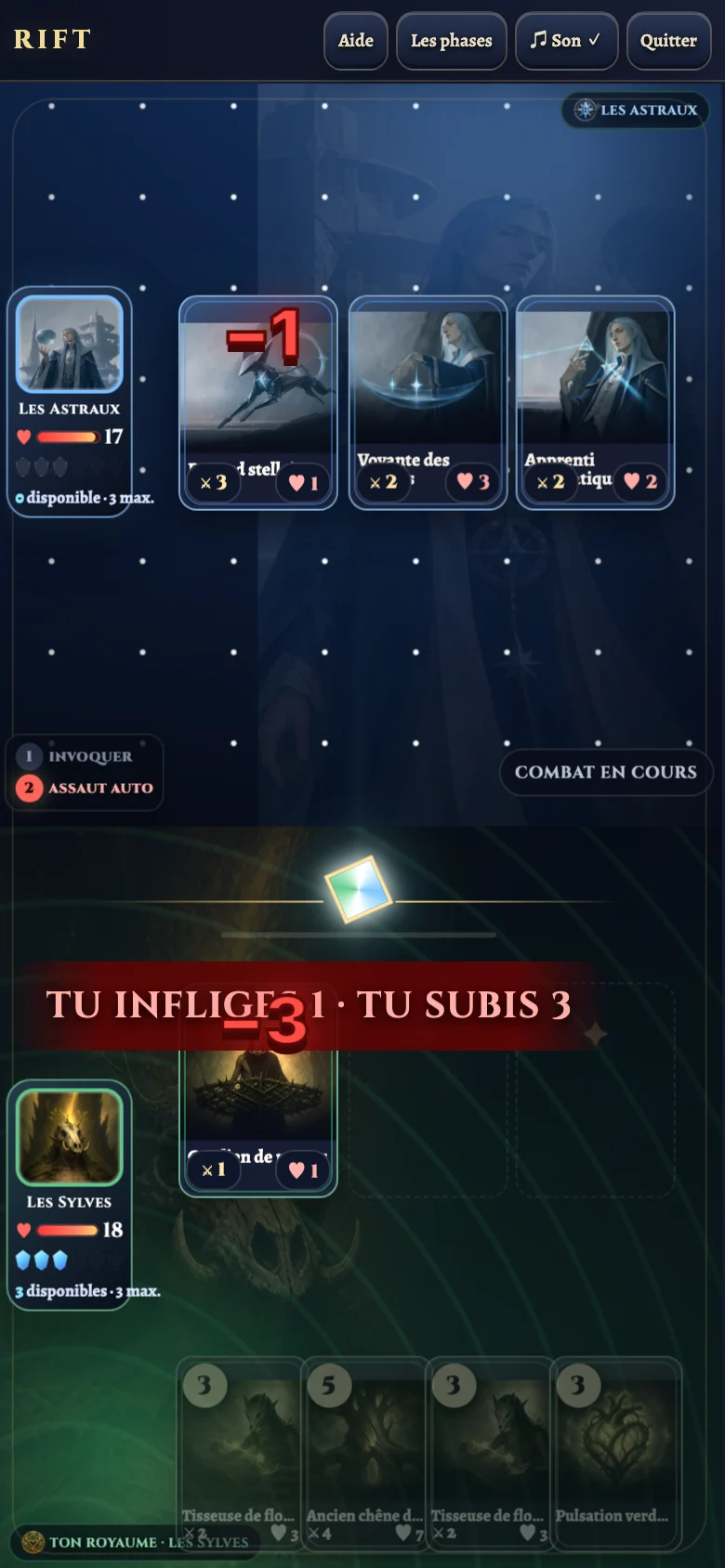
The same game, on a phone
The board plays in portrait, with the same rules and the same cards. Nothing is removed, nothing is simplified, it is the format the game was composed for.
On a computer, the table rises into 3D, scenery, not another way to play. On a phone it's the flat board, and that is a choice: a card game reads better flat, under one thumb.
The grimoire
The rules, as the game hands them to you
They fit on one page, and the game opens it at your first duel. These are exactly the same words.
What else you need to know
Three things that decide close duels.
- Guard
- A creature with guard intercepts the assault aimed at your hero. As long as it holds, he cannot be touched.
- The Rift
- It feeds on every creature that falls. Once it reaches its threshold, it strikes both sides, it is on nobody's side.
- Souls
- They come back every turn, and you gain one more. Whatever you do not spend is lost.
The waiting list
The rest is played, not read
One address, and you play your first game on launch day, early January 2027.