 RIFT
RIFTArticle · 21 August 2026
Why RIFT has no lands
It's the first question people ask, and the easiest decision to defend: in RIFT, the resource rises on its own. Nobody loses because they drew badly.
The flaw everybody knows
In most of the great card games, one game in five is decided before it starts. You drew too many lands and have nothing to play, or too few and nothing to play it with. We call it variance, we shrug, we shuffle again.
It isn't an accident: it's the price of a mechanic that brings real decisions with it, what to lay down, when, in what order. But the price is paid by the beginner, and it is paid at the worst possible moment: their very first game.
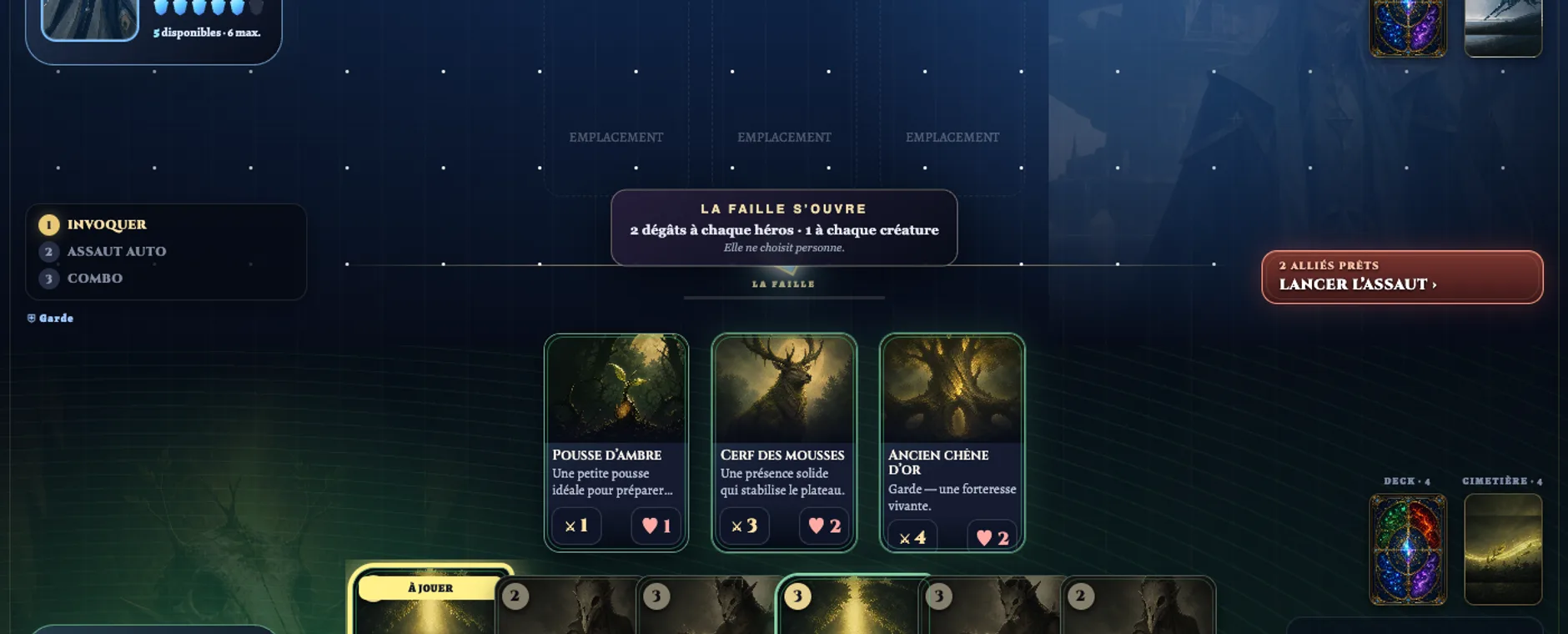
In RIFT, energy isn't drawn. It rises on its own: one soul on the first turn, one more each turn, six at most.
What it removes
Everything above. Both players have exactly the same means at the same moment. A game lost is a game played badly, not a game dealt badly. It's a short sentence and it is the foundation of the game: you can lose without having been robbed.
An immediate consequence: a RIFT deck contains only cards you want to play. Fifteen cards, fifteen intentions. No slot lost to the mechanic itself.
What it costs, honestly
Two things, and they need saying.
Curves look more alike. When everyone has the same ramp, you can no longer build a deck that "accelerates" or "stalls" by playing on its lands. The difference has to come from elsewhere: from card costs, from combos, from the moment you choose to launch the assault.
The opening is more predictable. On turn one, everyone has one soul, and the options fit in a hand. That is restful for someone discovering the game, less surprising for someone with a thousand games behind them. We own that: RIFT is made to be playable on a commute, not to reward memorisation.
And the idea we laid on top
A resource that rises on its own is neutral. It could belong to any game. So we gave it an origin: those souls come from the Rift, the tear that threatens the kingdoms and strikes both sides when it opens.
What you play with comes from what threatens you. Nobody signed that pact, and everybody lives off it.
It isn't dressing: it's what ties the resource, the name of the game, and the only player at the table who belongs to nobody. The world says more.
Jean-Christophe Martinez · author of RIFT
The waiting list
Play a game without ever having drawn badly
One address, and you're told at launch, early January 2027.